

Category: Drama, Romance
Written By: Shamar (Vibez) Binns Date: 02/07/25
Love Me
Love Me presents a fascinating and ambitious concept: two artificial beings attempting to understand humanity, identity, and romantic love long after the human race has disappeared. A weather buoy and an orbiting satellite find one another across the emptiness of a post-apocalyptic Earth, creating a relationship that stretches across billions of years. Unfortunately, the film never fully reaches the emotional or visual potential of that incredible premise.
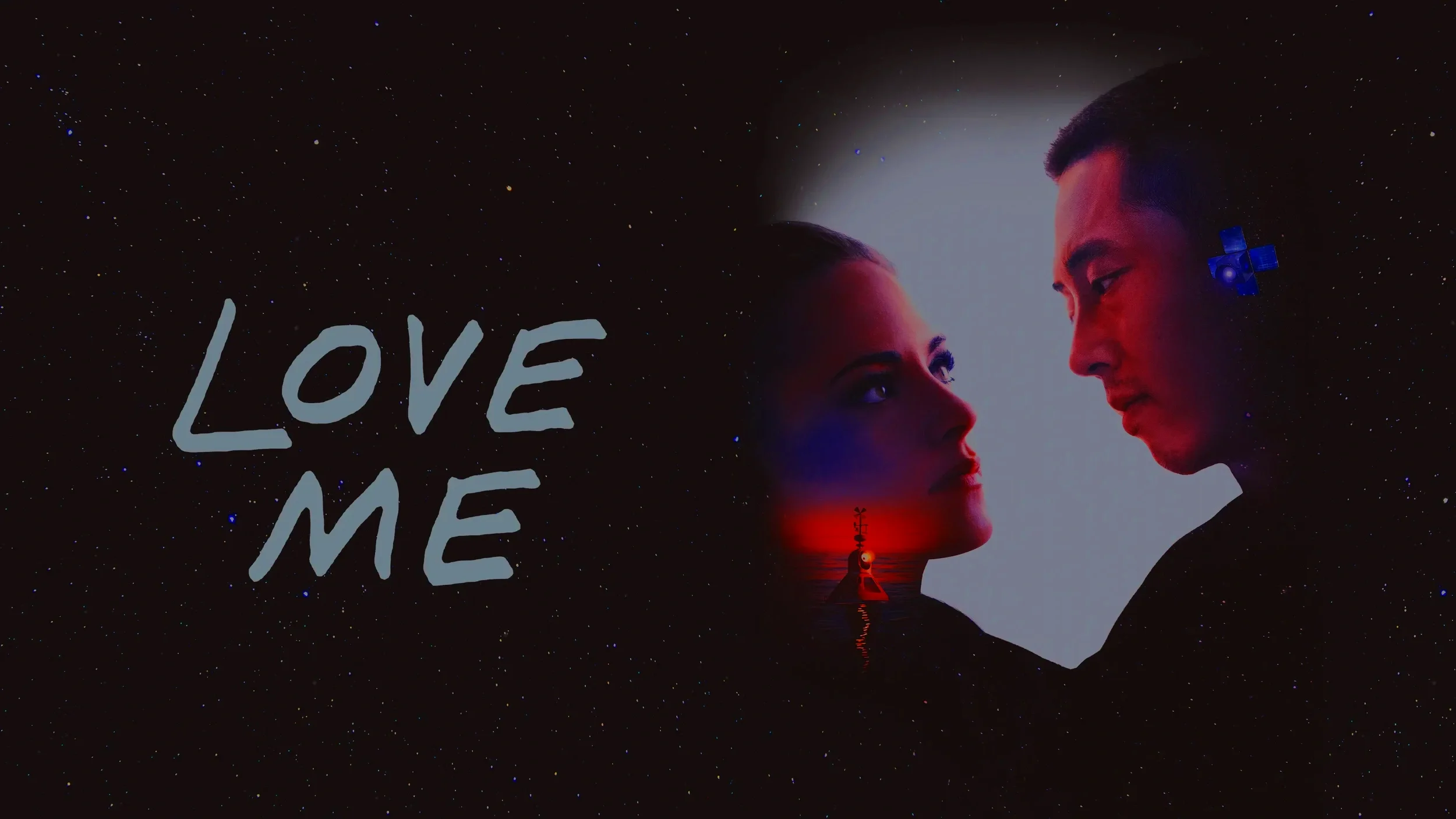
The story follows an AI-powered buoy called Me and a satellite named Iam. With humanity extinct, the two machines use the remains of the internet to learn what people were like. They study social media, videos, language, relationships, and human behavior as they attempt to understand what it means to exist and connect with another being.
Rather than building identities from their own experiences, they begin imitating an online influencer couple. Me models herself after Deja, while Iam becomes a version of Deja’s partner, Liam. Together, they construct a digital apartment and repeatedly recreate the couple’s seemingly perfect online relationship.
That idea gives Love Me one of its most interesting themes. These artificial beings are learning about humanity through social media, but social media rarely presents the full truth about anyone. They are copying carefully staged videos, artificial happiness, romantic routines, and personalities designed for an audience. Their understanding of love begins with a performance rather than a genuine emotional connection.
Writers and directors Sam and Andy Zuchero deserve credit for attempting something this experimental in their feature debut. The movie combines physical machines, animation, motion capture, digital avatars, and live-action performances to show the characters evolving over an enormous period of time. Their creative ambition is visible throughout the film, even when the story does not always come together.
The directors use the transformation of Me and Iam to represent their growing understanding of identity. They begin as machines communicating from a distance, become animated figures inside a virtual environment, and eventually appear through the physical performances of Kristen Stewart and Steven Yeun. Each new form is supposed to bring them closer to understanding human existence.
However, the concept promises a much larger journey than the movie delivers. These characters possess the ability to create almost anything within their shared virtual reality, yet most of their relationship remains confined to the same digital apartment. For a story spanning billions of years and exploring the endless possibilities of artificial intelligence, the world begins to feel surprisingly small.
The apartment works as a representation of the artificial relationship they copied from social media, but the film spends too much time there. Me and Iam could have created entire worlds, traveled through different periods of human history, recreated different cultures, or explored the many forms love can take. Instead, they repeatedly return to the same room and the same limited understanding of romance.
This is the film’s greatest missed opportunity. Love is not only romantic. It can exist between families, friends, communities, cultures, and even within someone learning to accept themselves. The movie raises the question of what “real love” means but approaches the answer through a narrow and repetitive relationship.
The film becomes so focused on defining love that the emotions occasionally feel more like a philosophical exercise than something natural. Me and Iam discuss, imitate, analyze, and perform romance, but the screenplay does not always make the audience feel the connection it wants us to believe they share. The ideas are present, but the emotional experience remains distant.
Kristen Stewart still delivers a committed and emotionally complicated performance as Me and Deja. She captures the character’s insecurity, obsession, excitement, jealousy, and desperate need to be accepted. Me does not simply want to experience love; she wants to create a version of herself that she believes deserves to be loved.
That struggle connects the film’s artificial intelligence premise to a deeply human experience. Many people use social media to build idealized versions of themselves, hoping that a more attractive or successful identity will bring acceptance. Me does the same thing, hiding the truth of her physical form because she fears Iam will reject her if he sees what she really is.
Steven Yeun brings warmth, curiosity, and frustration to Iam and Liam. His character initially follows Me into her fantasy, but he gradually begins questioning whether endlessly recreating someone else’s relationship can ever become real. Yeun gives Iam a desire for something spontaneous and honest, even when the screenplay struggles to define what that honesty should look like.
Stewart and Yeun carry the movie almost entirely through their performances. Their chemistry gives the story moments of humor, tenderness, discomfort, and sadness. Both actors fully commit to the unusual material, moving between voice acting, motion capture, exaggerated digital behavior, and more grounded live-action performances.
The cinematography and visual effects are sleek and creative, particularly during the film’s early sections. The lonely image of a buoy floating on an empty ocean while a satellite circles a lifeless planet immediately establishes the enormous scale and sadness of this world. Those opening ideas create a haunting sense of isolation that the rest of the film never completely matches.
The visual transitions between mechanical, animated, and human forms are also impressive. They reflect the characters’ changing perception of themselves, but the movie does not always use these transformations to move the story forward. After the initial visual excitement, several sections become repetitive.
The story’s enormous timeline should create a powerful feeling of cosmic loneliness. Centuries and even billions of years can pass while Me and Iam continue trying to understand one another. However, the passage of time often feels like background information rather than something carrying real emotional weight. The movie tells us their relationship survives across an unimaginable period, but it rarely makes that scale feel real.
Love Me is at its strongest when examining how identity is created. Me learns to see herself through images left behind by humanity, while Iam attempts to determine whether they can become something original rather than copies. Their conflict raises meaningful questions about whether anyone truly creates an independent identity or simply builds one from the people, stories, and cultures they encounter.
The film also asks whether artificial emotions become real when the person experiencing them believes they are real. Me and Iam were created by humans, but their loneliness, fear, desire, and pain begin developing beyond their original functions. Their relationship challenges the idea that love must come from a biological human mind to have meaning.
Unfortunately, these questions are often more interesting than the answers the movie provides. The screenplay introduces ideas about artificial intelligence, social media, consciousness, loneliness, performance, and the end of humanity, but it cannot explore all of them with equal depth. The result is thoughtful but emotionally uneven.
Although the film leaves certain questions unanswered, that ambiguity is not necessarily a weakness. Love Me wants audiences to leave the theater discussing what they witnessed and deciding whether the relationship was genuine. The problem is that the journey toward that ending does not always feel as rich or moving as the concept deserves.
Sam and Andy Zuchero demonstrate strong imagination and a willingness to take creative risks. Their use of multiple visual formats makes Love Me different from a traditional science-fiction romance. Still, the film often feels like an excellent short-film concept stretched across a feature-length runtime without enough new environments or emotional developments to sustain it.
In the end, Love Me is an ambitious and visually polished experiment supported by strong performances from Kristen Stewart and Steven Yeun. It offers meaningful questions about identity, artificial intelligence, social media, and humanity’s need for connection. However, its repetitive setting, narrow definition of love, and emotional distance prevent it from becoming the sweeping cosmic romance it could have been.
Love Me reaches across billions of years to ask one of humanity’s oldest questions, but its answer remains trapped inside a single room. Thought-provoking and creative, yet ultimately underwhelming, the movie leaves me wishing its filmmakers had taken even greater risks with the world they created.